Book 1 → TheQuietConfidenceBook.com | Book 2 → TheLeadershipOSBook.com
Your System Is Working. The Tension Isn't Going Away.
Most leadership problems have solutions. This book is for the ones that don't, the recurring tensions that aren't signs your system is broken, but proof that it's working correctly inside an environment that doesn't resolve.
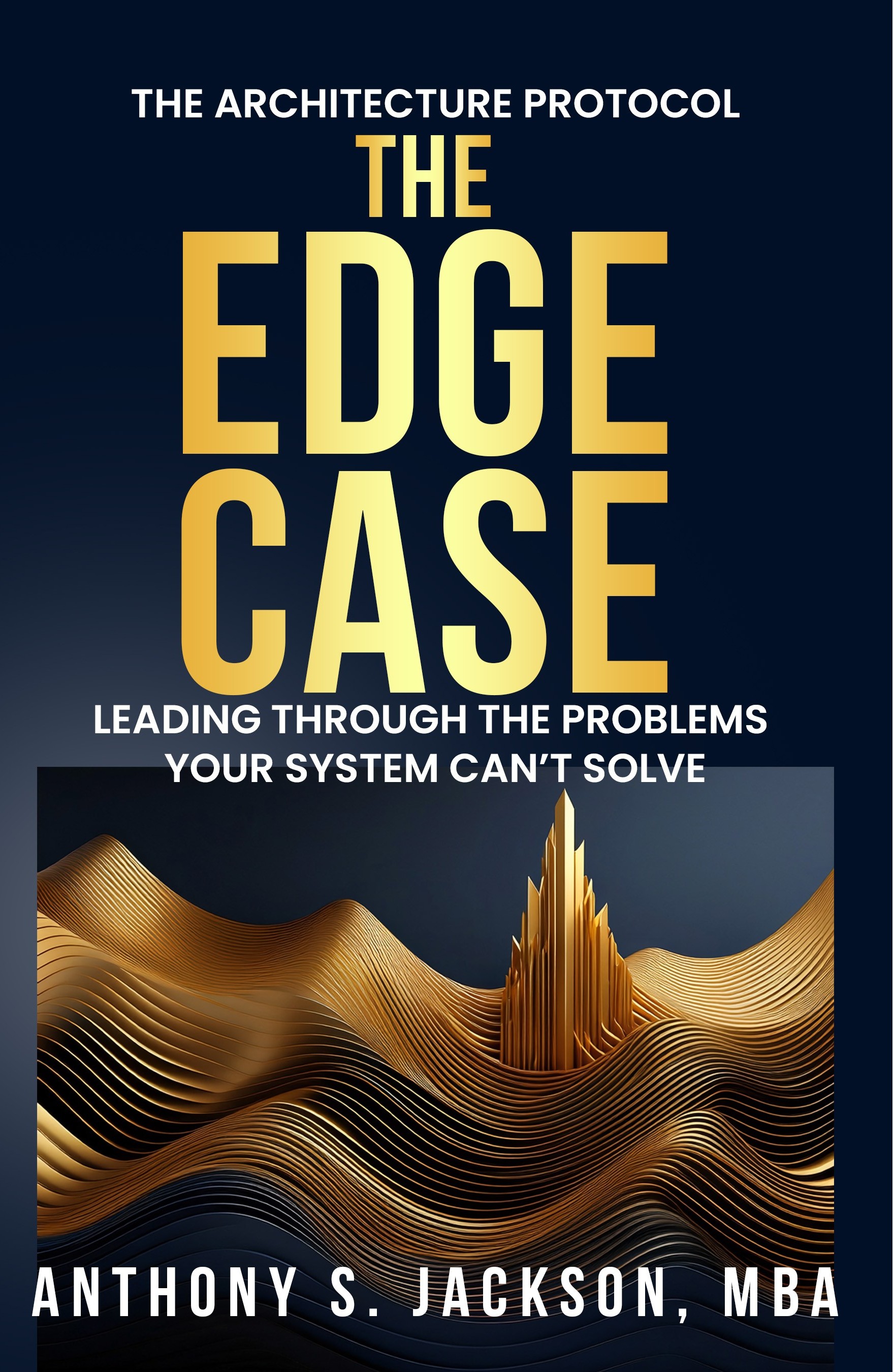
The Edge Case (Book 3 in The Architecture Protocol Series): The structural field guide for technical leaders navigating the problems their operating system can't solve.
You already know this feeling.
The roadmap-sprint tension that resurfaces every quarter. You've discussed it, documented it, and restructured it. It returns, in slightly different form, with slightly different names. The people involved change. The substance doesn't.
The vendor your architecture depends on who operates at a tempo your team can't match, and can't change. The constraint isn't in your system. It's at the boundary where your system meets theirs.
The senior leader who had the answer in the room and said nothing, not because they didn't know, not because they were afraid, but because the structure didn't give their answer a place to land. You've been that person. You'll be that person again. This book has a name for that gap: Read Access. And once you have the name, you stop reading the silence as failure.
You're not failing to fix these tensions. You're managing them. The difference is the whole game.
Nobody told you that some of the hardest problems in technical leadership aren't problems at all, they're structural properties of the environments you're operating inside. You were trained to fix things, to architect solutions, to resolve ambiguity. The assumption was that persistence and better systems would eventually clear the tension. For the tensions this book names, persistence is not the answer. Better architecture is not the answer. Naming what you're actually managing, and holding it without flinching, is the work.
There is an assumption built into every well-designed system.
At this level, it takes its most sophisticated form: a well-designed system should eventually resolve its recurring tensions. Persistence will get there. Better architecture will get there. If it keeps returning, something still needs to be fixed. This version of the Competence Assumption is the hardest to name because the leaders it affects are the ones who have already beaten it twice, they have built the internal foundation, they have built the team architecture, and the assumption has followed them into the next room.
They have built well enough. The tensions that keep returning are not a design flaw. They are a property of the environment the system is operating inside. Naming them is not a consolation prize. It is the work.
The roadmap-sprint friction returns each quarter because two legitimate systems, one running on committed delivery dates, one running on discovered complexity, are operating at different clocks by design, not by mistake. The knowledge that can't be acted on accumulates because read access and write access don't always live in the same person, and the difference is structural, not political. The tensions that outlast your best redesigns do so because they're not misalignments to correct, they're load-bearing points where two systems meet and neither can fully prevail.
You're in a planning session. Someone at the table is describing a tension the team has been navigating for the better part of a year: roadmap commitments on one side, sprint capacity on the other. You've seen it before. You'll see it again.
Somewhere in the second hour, you realize something: you're not in a problem-solving conversation. You're in a naming conversation; the team is trying to find the right words for something they've repeatedly tried to fix, which has returned in a slightly different form but feels exactly the same.
The tension is not a failure of execution. It's a property of the system. You know this, somewhere below articulation. You don't have the language for it yet. So the meeting ends with another action plan, another structural adjustment, another set of owners. The tension will be back in three months.
What changes is not the tension. What changes is whether you have a name for it.
These aren't fixable problems you haven't reached yet. They're structural bearings, and once you can name what you're holding, you can stop fighting it and start designing around it.
The Architecture Protocol Series: Three Books. Three Transitions. One Sequence.
I have spent thirty years inside technical organizations, watching the same tensions resurface with the same force in completely different companies, teams, and industries. This book is what I learned from that pattern, and what changed the moment I stopped trying to fix what isn't broken.
The tension that keeps returning isn't evidence that something is wrong.
It's evidence that your system is working inside a structure that doesn't resolve.
Read this page if you've done the internal work: if you're past the identity questions that come with a new management role, if you've built systems that mostly run without you, and if you're now navigating recurring tensions that your best design hasn't resolved. If you can describe a tension in your organization that has outlasted at least two serious attempts to fix it, this book was written for you.
This book is not the right starting point if you haven't yet stabilized internally as a leader, or if you're still in the phase of building your team's basic operating system. The tensions this book names are only visible when the fixable problems have been fixed. If you're still in that work, Quiet Confidence and LeadershipOS™ are the right foundation.
If you are past that threshold and you're ready to name what you've been managing without language, you are in the right place.
The Edge Case is written for technical leaders who are already running good systems and still have unresolved tensions. It does not ask you to try harder or design better. It gives you a framework for what you're actually managing and a vocabulary for how to talk about it.
This is not a problem-solving book. It is a naming book. The naming is the solution.
The problem you're navigating is not a design flaw. It's a structural bearing.
Most technical leadership books are built on the assumption that the right framework, process, or design will eventually resolve your organization's hardest tensions. The Edge Case starts from a different premise. Some tensions aren't resolvable; they're structural properties of the environments you're operating inside. The organizations that manage them well don't solve them. They name them, design around them, and stop treating them as evidence of failure.
Structural Bearings™ aren't new problems. They're the problems you've been managing without a name.
This book names six of them.
It introduces the Structural Bearing™: the element that transfers load between two systems at their interface. In engineering, a structural bearing holds weight at the boundary between two parts of a structure. In organizations, it's the named tension that can't be resolved because both sides are operating correctly. The vendor who delivers on a different clock. The knowledge that can't be voiced because the authority doesn't follow the expertise. The legacy system and the new architecture have to coexist, permanently, at the seam.
The book moves through six bearing types, each one surfacing a different category of permanent organizational tension.
Read Access. The gap between knowing and being positioned to act on what you know. The campsite story that opens the book: a fifteen-year-old on a camping trip who could see what needed to change and had no structural position to say so, is not an origin story. It's a taxonomy. Technical leaders live in this gap throughout their careers.
Lossy Compression. What happens to organizational knowledge as it moves up the chain. Every translation loses something. The question isn't how to prevent the loss, it's how to know what was lost and design for it.
Clock Drift. Two systems operating on incompatible tempos by design. The roadmap-sprint tension isn't a process problem. It's a clock problem, and the clocks were built that way on purpose.
Shadow State. What new arrivals see that insiders can no longer see. The fresh perspective isn't naive. It's an X-ray. The question is how to hold what it reveals without destroying the culture that made it invisible.
Load Bearing. Both systems functioning correctly. The tension is permanent. Naming it is as good as it gets, and naming it is everything.
Fault Line. The boundary tension between two organizations, two teams, or two systems that will never fully merge. The edge where each one stops and the other begins. This is the chapter for the tension you've been calling misalignment for years.
Each chapter ends not with a solution but with a Two-Sentence Brief™: the artifact that emerges from the diagnostic: a precise formulation of the structural constraint that changes how your entire leadership team thinks about what they've been navigating.
What you'll build:
- A working vocabulary for six categories of organizational tension that don't resolve, so you can name what you're managing instead of fighting what you can't fix
- The Constraint Architecture™ method: how to map the load on both sides of a tension, locate the constraint that makes resolution impossible, and reason about likely futures rather than seeking certainty
- The Two-Sentence Brief™: the communication artifact that makes a complex structural situation actionable without oversimplifying it
- The specific diagnostic moves for each bearing type, what holding it well looks like, versus what treating it as a fixable problem costs you
- Why naming is the resolution, not a consolation prize, but the actual mechanism that changes what's possible
Four things change when you can name what you're holding.
1. The recurring tension stops costing you the same meeting twice. Not because the tension resolves, it won't. Because you stop entering those conversations as if they should. You arrive with the right frame: this is a bearing we're managing, not a problem we're about to solve. That reframe alone changes the quality of every planning session, every cross-functional review, every conversation where the same thing keeps returning.
2. The knowledge that can't be acted on stops accumulating as frustration. You've been inside the room where someone knew what needed to happen and couldn't say it structurally. You've been the person. The Read Access bearing doesn't disappear when you name it, but you stop treating the silence as failure, yours or theirs. You start designing for it: how do you create the contribution that the structure will accept? That's a solvable question. Resenting the gap is not.
3. The tensions that used to define your limits start defining your range. A technical leader who can hold a structural bearing without flinching, who can name it for a room full of people who've been fighting it for years, who can deliver a Two-Sentence Brief™ that changes how a leadership team thinks about the problem, that is a different kind of leader than the one who is still trying to fix what isn't broken. The Edge Case Paradox: the problem you cannot fix is the one that makes you someone to be followed when the next one arrives.
4. The vocabulary becomes the frame your team operates inside. The leaders who develop this vocabulary don't just use it privately. It spreads. Once your team has language for "we're managing a clock drift, not solving a coordination failure," the conversation about the roadmap-sprint tension changes permanently. The framework isn't intellectual furniture. It's how the room starts thinking.
What would it be worth to you, this year, in the next difficult planning cycle, to walk in already knowing what you're managing?
Why I Wrote This Book
I was fifteen years old at a campsite in Vermont when I first understood what it cost to know something you couldn't say.
My father was assembling a new tent, never used before, with poles labeled incorrectly by the manufacturer. I had four years of Boy Scout camping behind me. I could see exactly how it went together. I could have set it up in ten minutes. I was fifteen. He was my father. So I stood there for two hours.
What I filed afterward wasn't resentment. I filed the architecture: the way a room can contain two people, with the knowledge on one side and the authority on the other, and the knowledge stays quiet because that's what the structure requires.
Twenty years later, in July 2010, I watched someone else read that architecture incorrectly. I was at IPG. A CFO for a subsidiary wanted to see the finished product in a demo. I told the subsidiary's CTO. He effectively told me I was outside my pay grade and demoed the backend instead. The CFO pulled me aside afterward. Within a week, the project folded and the subsidiary closed.
Two hours at a campsite. One week, and a project.
I spent thirty years accumulating cases like those, in different organizations, with different names, with the same structural signature. The tensions that didn't resolve weren't failures of execution. They were structural properties of the environments I was operating inside. What I eventually understood is that the return isn't evidence of failure. It's the signature of a permanent tension: a load-carrying point where two systems meet and neither can fully prevail.
This book is also the most personal thing I've written, because I wrote it from inside the most live version of the bearing it describes. When the acquisition chapter was written, it wasn't a retrospective; I was in the middle of it as this book went to press, and I was legally prohibited from saying what I knew. That constraint is also why this book didn't ship the day it was finished. The situation has since resolved. That's where the authority in this book comes from.
The tensions I spent years trying to resolve were never the problem. The framework for managing them, naming them precisely, mapping the load on both sides, designing around what won't change, is the work my whole career was building toward. That's what this book gives you. Not the resolution. The capacity.
I have spent thirty years inside the tensions this book names. The vocabulary in these pages is not theoretical: it comes from cases that didn't resolve, from patterns that returned in different companies with the same structural signature, from thirty years of learning to hold what won't fix rather than fighting what isn't broken. You cannot manage a Structural Bearing™ you haven't named. That is not a metaphor. It is the mechanism.
The Edge Case is $24.97, delivered to your door. If it doesn't do what it says, send it back within a year of receipt: full refund, book and shipping, no interrogation.
The only thing I ask: read it.
Anthony's Bold Guarantee
If you read this book and it doesn't deliver, for any reason, no explanation required, send it back within one year. I will refund every penny. The book cost and the shipping, both.
No interrogation. No friction. No asterisk.
I've been inside enough organizations to know when something works and when it doesn't. This works. If it doesn't work for you, I want to know that too.
Send it back. You'll hear from me directly.

About Anthony S. Jackson
I have spent thirty years watching the same tensions resurface in completely different organizations, with different names, different people, and the same structural signature. For most of that time, I tried to resolve them. What I eventually understood is that the return is not evidence of failure. It is the signature of a permanent tension: a load-carrying point where two systems meet and neither can fully prevail. This book gives those tensions a name. The cases it draws from span thirty years, and the most recent one was still unfolding when it went to press.
I do not teach leadership as a personality trait. I engineer it as a system because I have watched good people fail inside bad ones, and I decided a long time ago that good people deserve better architecture.
I have spent thirty years inside technical organizations, as an individual contributor, engineering manager, director, VP, and CTO-level leader. I have led teams ranging from 5 to 40+ across healthcare tech, SaaS platforms, enterprise software, and consulting. I have been laid off, left with the scars of organizations that collapsed from within, built platforms that scaled, and designed leadership systems that outlasted me. Versions of this system are running in technical organizations right now, through leaders I worked with directly before this book existed. I cannot name them, but they are out there, and their experience is baked into what you are reading.
The Edge Case is the product of thirty years of pattern recognition: watching the same structural tensions resurface in completely different organizations with the same force and the same signature, learning that the best leaders don't solve these tensions but name and hold them, and eventually building a framework precise enough to be genuinely useful when you're in the room where the tension lives. The cases in this book are real. The vocabulary is new.
Every month, I write about what technical leaders are actually navigating inside the LeadershipOS™ Inner Circle. I also work with technical leaders through group programs and advisory engagements. For leaders navigating a specific structural bearing and ready to name it precisely, I offer the Structural Bearing™ Diagnostic: a 90-minute session that maps the load on both sides of the tension, identifies the constraint making resolution impossible, and produces a Two-Sentence Brief™ your leadership team can act on immediately.
I am the author of Quiet Confidence, LeadershipOS™, and The Edge Case, the three books of The Architecture Protocol Series.

Read it before you buy it. Chapter 1 is yours free.
If you made it this far and you're still deciding, Chapter 1 is yours free. It's called "Read Access" and it covers the bearing type the rest of the book builds from: what it costs to know something you can't act on, why that gap is structural rather than political, and what changes the moment you can name it precisely. If you've ever been the person in the room with the answer and no structural position to give it, this chapter will leave a permanent mark on how you understand that experience.
Privacy Policy | Terms of Service
You'll be added to my email list for technical leaders. Each email covers one idea from inside the framework. Nothing motivational. Nothing generic. One thing that changes how you see the week you're already in.
Or: